

This post may contain affiliate links. If you buy through them, we may earn a small commission at no extra cost to you. Learn more
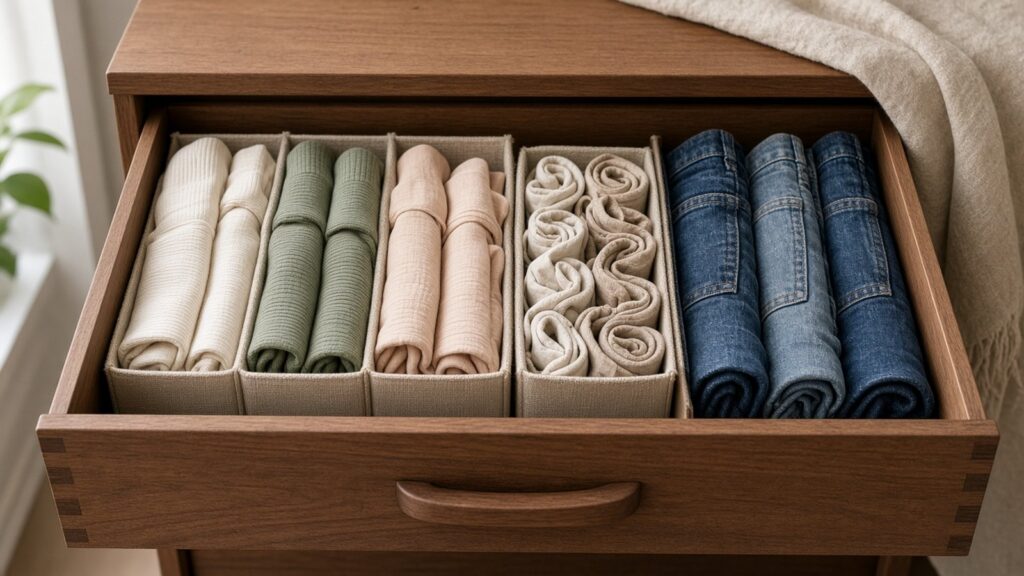
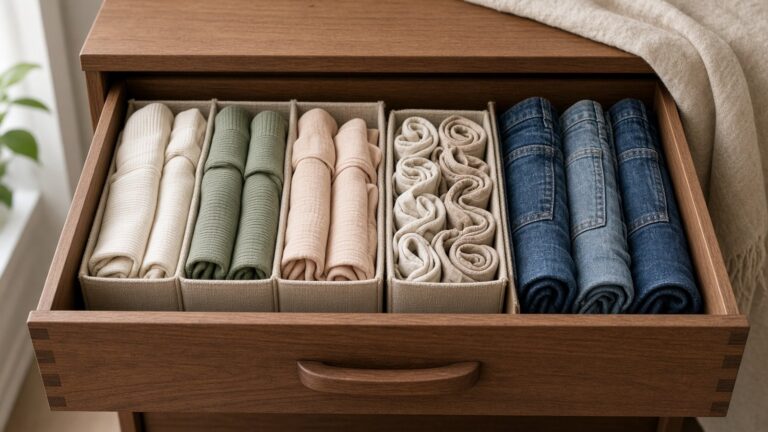
File folding is the simplest way to fit more clothes into the drawers you already have. Instead of stacking shirts in piles, you fold each piece into a small, firm rectangle and stand it upright on its edge, like files in a cabinet. If you have been searching for how to fold clothes to save space, this is the method to learn first: you can see every item at a glance, pull one out without wrecking the rest, and usually fit noticeably more into the same drawer.
Below you’ll find step-by-step folds for t-shirts, long sleeves, jeans, sweaters, leggings, underwear and socks, how to arrange them by drawer height, which clothes should not be file-folded at all, and the mistakes that make upright drawers collapse.
What Is File Folding (and Why It Saves Drawer Space)?
File folding means folding clothes into compact rectangles that can stand on their own, then lining them up vertically in rows from the front of the drawer to the back. The same idea is often called vertical folding, and it is the core of the KonMari folding style popularized by tidying books.
It saves space for three practical reasons:
- No wasted air on top. Stacks rarely reach the top of a drawer exactly, and the gap above them is lost. Upright rows use the full height of the drawer.
- No hidden bottom layer. In a stack, the shirts at the bottom are forgotten. In rows, every item is visible, so you wear what you own and notice what you could let go.
- Grab one, disturb nothing. Pulling a shirt from a row leaves the others standing, so the drawer stays tidy for weeks instead of days.
If your drawers are overflowing before you even start, do a quick edit first. Our decluttering checklist of 50 things to throw away covers worn-out tees, mismatched socks and other easy wins.
How to Fold Clothes to Save Space: The Basic File Fold
Every garment below uses the same three-part logic. Learn it once and the rest is just small adjustments.
- Make a long rectangle. Lay the item flat, smooth it, and fold the sides (and sleeves) in so you get a straight-edged rectangle.
- Fold it into a small packet. Fold the rectangle in half, then in half or thirds again, until it is roughly as tall as your drawer is deep minus an inch or so.
- Test it. Set the packet on its edge on a table. If it stands up without help, it is ready. If it flops, fold it once more or fold more firmly.
Step-by-Step Folds for Every Garment
How to fold shirts to save space (T-shirts)
- Lay the T-shirt face down and smooth out wrinkles.
- Fold one side in toward the center, roughly a third of the width, and lay the sleeve back along that fold so it points down the shirt.
- Repeat on the other side. You now have a long rectangle.
- Fold the bottom hem up to about an inch below the collar, then fold in half or thirds again until the packet fits your drawer height.
- Stand it up with the folded edge facing up so you can see the color.
Long-sleeve shirts and lightweight tops
- Lay the shirt face down and fold one side in toward the center.
- Fold the long sleeve back down along the body, then zigzag any extra length so it stays inside the rectangle.
- Repeat on the other side, then fold from the hem up into thirds.
- Button-down shirts in cotton or flannel can be file-folded too: button the top and middle buttons first so the front stays flat.
Jeans and pants
- Fold the pants in half lengthwise so one leg lies on top of the other.
- Tuck the small triangle at the back of the seat inward to make a straight edge.
- Fold the legs up toward the waistband in half, then in half again (or thirds for long inseams).
- Stand the packet with the folded edge up.
Jeans too long to fit? Roll them tightly from the hem and line the rolls up side by side in a deep drawer.
Sweaters and sweatshirts
Lightweight knits and sweatshirts can be file-folded. Fold the sides and sleeves in as for a long-sleeve shirt, keeping the rectangle a little wider, then fold in half or thirds. Fewer folds keep thick fabric from creasing hard. Chunky knits are a different story; see the section on when not to file-fold below.
Leggings and workout pants
- Fold in half lengthwise, legs together.
- Fold in half again from the ankles to the waist.
- Fold or roll into a small packet until it stands on its own. Stretchy fabric holds a roll well, so either works.
Underwear
Fold briefs and boxers into thirds lengthwise (sides in), then fold up from the bottom into a small square or roll it tightly. Bras with molded cups should not be folded in half; nest them one inside the other in a row instead, so the cups keep their shape.
Socks
Skip balling socks together, which stretches the cuffs. Lay a pair flat, one sock on top of the other, then fold in half or thirds (or roll ankle socks) and stand them upright. Small open bins keep sock rows from sliding into the rest of the drawer.
How to Fold Clothes in Drawers: Arranging by Drawer Depth
Once everything is folded, how you set up the drawer matters as much as the folds. Start by measuring the inside height of each drawer, then match clothes to drawers:
- Shallow drawers (about 3 to 5 inches tall): socks, underwear, tights, small accessories. Fold these items small so they stand below the rim.
- Medium drawers (about 5 to 8 inches): T-shirts, tanks, leggings, pajamas. Most tops fit here when folded into thirds.
- Deep drawers (8 inches and up): jeans, pants, sweatshirts and light sweaters. Use fewer folds so the packets are taller and keep their shape.
Then follow these setup rules:
- Rows run front to back. Lay the folded edges facing up and line items so you can read them like book spines.
- Light to dark, or by type. Arrange each row by color or by category (work, weekend, gym) so you find things in seconds.
- Divide wide drawers. A wide drawer lets rows lean and fall over. Fabric bins or dividers turn it into narrow lanes. A set like the SpaceAid 12 pack drawer organizers for clothes gives you three bin sizes that are 4.5 inches tall, so check that your drawer is a bit taller than that before buying.
- Fill each row, but not too tight. Items should support each other without having to be pried out. Leave about one packet of wiggle room per row.
- Use the front for daily items. Everyday tees and socks go up front; less-used pieces go in the back rows.
Short on drawers entirely? File-folded clothes also work in shallow bins on closet shelves or in rolling bins under the bed; see our under-bed storage ideas for small bedrooms for which containers fit low bed frames.
When Not to File-Fold (Hang or Stack Instead)
File folding is great for everyday cotton and stretch fabrics, but it isn’t right for everything:
- Bulky knits. Chunky sweaters take up a whole row by themselves and can lose their shape when squeezed upright. Fold them loosely and stack two or three on a shelf, or use hanging closet shelves if your closet has no built-in shelving.
- Delicate fabrics. Silk, satin, chiffon and anything lined or beaded crease easily and may snag in a packed drawer. Hang them on padded or velvet hangers.
- Structured pieces. Blazers, dress shirts you wear ironed, tailored trousers and dresses keep their lines better on hangers.
- Anything damp. Only fold clothes that are completely dry, or you risk musty smells in a closed drawer.
Working with a tiny wardrobe? Our guide to organizing a small closet with no built-ins shows how to add shelves and double-hang rods without drilling, so hanging items have a home too.
Common Mistakes
- Folding too big. Packets taller than the drawer get crushed when it closes. Fold until each item sits a little below the rim.
- Folding too loosely. Soft, puffy folds slump. Smooth each item flat and press each fold firmly with your hand.
- Leaving wide drawers undivided. Without bins, boxes or even a shoebox as a divider, the last row always tips over.
- Packing rows too tight. If you have to pry a shirt out, the rows will be ruined within a week. Remove a few items or move them to another drawer.
- File-folding everything. Bulky knits and delicate fabrics do better hung or stacked; forcing them upright wastes space and wrinkles them.
- Skipping the edit. Folding clothes you never wear just organizes clutter. Pull out what doesn’t fit or isn’t worn before you start.
Quick Routine to Keep Drawers Tidy
- Fold laundry straight into packets as it comes out of the dryer, instead of in a pile on the bed.
- Put newly washed items at the back of each row so everything gets worn in rotation.
- Once a month, straighten any leaning rows and pull anything you skipped all month.
- Prepping a spare room? File-folded spare pajamas and towels make a guest drawer easy to set up; see our holiday guest room prep checklist.
Living in one room? The same upright rows work in under-bed bins and bookcase baskets, which our studio apartment organization ideas on a budget covers zone by zone.
FAQ
What is the best way to fold clothes to save space?
For most everyday clothes, file folding is the most space-efficient method: fold each item into a firm rectangle that stands on its own, then line items up vertically in rows. Rolling also works for stretchy fabrics, jeans and socks, especially in deep drawers.
Is rolling or folding better for saving space?
Both save space compared with flat stacks. File folding keeps edges neat and works well in shallow and medium drawers. Rolling is quick and suits stretchy fabrics, jeans in deep drawers and packing a suitcase. Many people mix the two: file-fold tops, roll leggings and socks.
How do you keep clothes standing up in a drawer?
Fold each item until it can stand on its own on a table, fill rows so items gently support each other, and break up wide drawers with bins, dividers or small boxes. If rows still tip over, the packets are too tall or too loose for that drawer.
What is KonMari folding?
KonMari folding is the name commonly used for the vertical folding style associated with Marie Kondo’s tidying method. Clothes are folded into small rectangles that stand upright in drawers, so you can see every item at once. File folding, as described in this guide, follows the same basic idea.
Conclusion
File folding takes a few minutes to learn and pays off every time you open a drawer. Fold each piece into a firm packet that stands on its own, match clothes to drawer heights, divide wide drawers into lanes, and hang the bulky or delicate pieces that don’t belong upright. Start with your T-shirt drawer today; once you see how much room it frees up, the rest of the dresser goes quickly.

Leave a Reply