
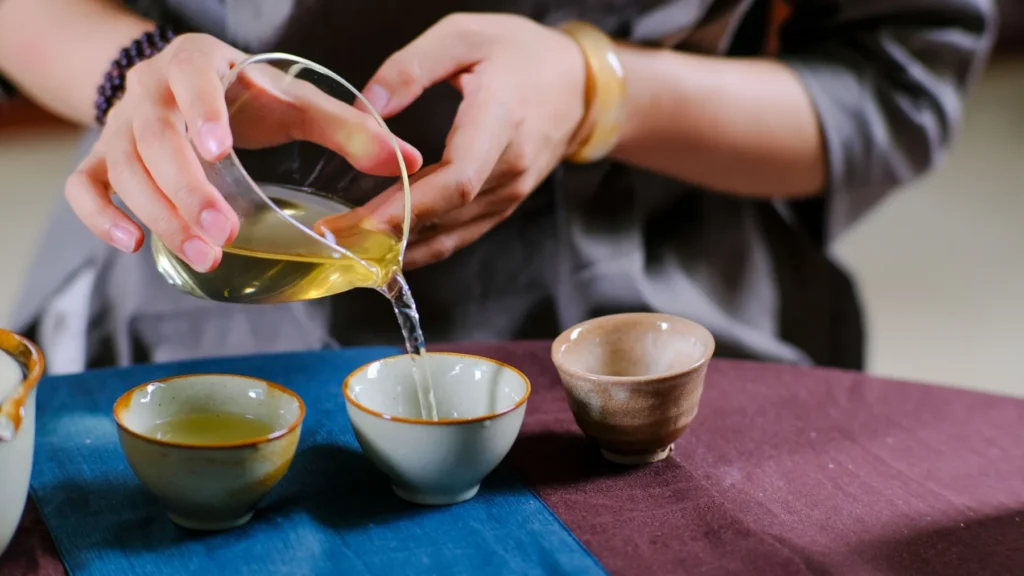
If you’ve spent any time looking into tea culture online, you’ve probably run into the term “Chinese tea ceremony” — usually attached to a video showing someone moving through a precise, almost choreographed sequence with a gaiwan or a small pot. It looks formal, rehearsed, almost sacred. And it gives the impression that there’s one correct, codified ritual behind Chinese tea drinking, the way there is with the Japanese tea ceremony.
There isn’t. And understanding why is actually one of the more useful things you can know as you get into Chinese tea.
Japan Has a Ceremony. China Has a Method.
The Japanese tea ceremony — chanoyu — is a formalized practice with defined steps, spiritual philosophy, specific tools, and training that can take years to master properly. It’s meant to be performed a certain way, rooted in principles like harmony and respect, and deviating from the form is considered a real departure from the practice.
Chinese tea culture developed differently. What people are usually pointing to when they say “Chinese tea ceremony” is actually gongfu cha — literally “tea made with skill” or “tea made with effort.” But gongfu cha isn’t a ceremony in the ritual sense. It’s better understood as a brewing method: a practical approach to making tea using a small vessel, high leaf-to-water ratio, and short, repeated infusions, refined to get the most flavor out of the leaves.
The “skill” in gongfu cha refers to technique — timing, temperature, pouring — not adherence to a fixed spiritual sequence. There’s no single correct order of movements, no required philosophy attached to it, and no formal certification defining who’s doing it “right.”
Why This Distinction Actually Matters
This isn’t just a technicality. It changes how you should approach learning it.
If you come in expecting a strict ceremony, you’ll spend your early attempts anxious about doing it “wrong” — worried you’re missing a step, using the wrong hand, or somehow disrespecting a tradition. That anxiety isn’t really warranted. Gongfu cha is more like cooking technique than religious ritual: there are principles that make the tea taste better, but plenty of room for personal style, regional variation, and simple trial and error.
Two people brewing the same tea with the same gaiwan can have noticeably different habits — how long they rinse the leaves, how quickly they pour, how many infusions they take before switching leaves — and neither is doing it incorrectly. That flexibility is a feature of the tradition, not a gap in it.
The Regional Variation Nobody Mentions
Another sign that there’s no single fixed “ceremony”: tea culture looks meaningfully different depending on where in China you are.
- Chaozhou-style gongfu cha (from the Chaoshan region) is intense and precise — very small cups, very short infusions, closely tied to hospitality and social ritual among friends and family.
- Sichuan teahouse culture is almost the opposite in spirit — relaxed, communal, often centered around large teahouses where people linger for hours over jasmine tea, playing games or chatting, with a much less formal brewing approach.
- Everyday household brewing across much of China is often just a gaiwan or a mug with loose leaves, no elaborate technique involved at all — tea as a daily habit, not a practice.
If there were one true “Chinese tea ceremony,” these wouldn’t look so different from each other. What actually exists is a shared set of tools and techniques that different regions and individuals have shaped to fit their own social habits.
What This Means for You as a Beginner
The practical takeaway: you don’t need to worry about performing gongfu cha “correctly” in some rigid, ceremonial sense. What you’re actually learning is a set of techniques — how to hold a gaiwan without burning yourself, how many infusions to expect from a given tea, how temperature affects flavor — that you can combine however suits you.
The small cups we covered in an earlier post aren’t part of a mandated ritual — they’re a practical design choice that happens to also carry social meaning. The repeated infusions aren’t a spiritual requirement — they’re just how you get the most out of good leaves. None of it is wrong to adapt once you understand why it’s done that way in the first place.
The Bottom Line
Chinese tea culture isn’t built around one fixed ceremony you need to learn perfectly — it’s built around a flexible method that’s been shaped differently by different regions, households, and individuals for centuries. Once that clicks, brewing tea stops feeling like something you could get “wrong” and starts feeling like a skill you’re simply getting better at, one cup at a time.
Want to start building that skill? Our guide on how to brew tea in a gaiwan without burning your fingers is a good practical starting point.
Pingback: A Minimalist's Guide to Starting a Home Tea Corner - LifeUpDaily
Pingback: Gongfu Tea vs Espresso Ritual: Two Cultures, One Idea of Slowing Down - LifeUpDaily