

This post may contain affiliate links. If you buy through them, we may earn a small commission at no extra cost to you. Learn more
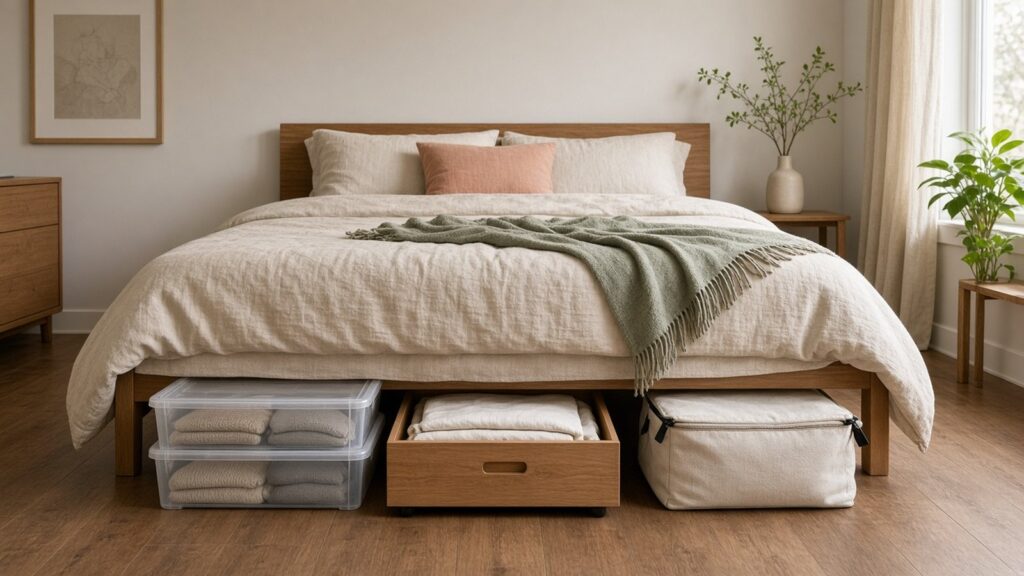
The best under-bed storage ideas for small bedrooms start with a tape measure, not a shopping cart. Measure the clearance under your bed frame, choose containers about an inch shorter than that gap, and match each container to what it holds: lidded boxes for off-season clothes, a rolling drawer for things you use every week, and soft zippered bags for bulky bedding. Keep the front edge for everyday items, the middle for rarely used ones, and label everything. If the bed sits too low, bed risers or a storage bed can create the space.
Below: how to measure, ten ideas that fit small rooms, a simple setup plan, what to store (and skip), common mistakes, and an FAQ.
Measure First: How Much Space Is Under Your Bed?
The wrong container either won’t fit or wastes half the gap. Five minutes with a tape measure saves a return trip.
- Clearance height. Measure from the floor to the lowest point under the bed: the side rail, a slat, a center support bar, or a box spring that sags in the middle. Measure at the edge and again about a foot in, because frames are often lower in the center. With a rug, measure from the top of the rug.
- Usable width. Measure between the legs on each side you can reach. Note any center legs or cross bars, since they decide how wide a single box can be.
- Depth. Measure from the edge of the frame to the center support or the wall. Most beds take one row of containers from each long side, or one row if the bed is against a wall.
- Pull-out room. A drawer or box needs its own depth in open floor beside the bed to slide out fully, which matters when a dresser or wall sits close by.
- Your target size. Subtract about an inch from the clearance for container height, and an inch or two from each width measurement. Write the numbers on your phone before you shop.
Which containers fit which clearance
| Clearance under the frame | What usually fits |
|---|---|
| Less than about 5 inches | Flat zippered bags, thin shoe organizers, or nothing at all (consider risers) |
| About 5 to 8 inches | Low lidded boxes, slim rolling drawers, sheet sets in flat organizers |
| About 8 to 13 inches | Taller lidded bins, rolling drawers with dividers, folded blankets |
| About 14 inches or more | Large soft storage bags, deep bins, or two layers of low boxes |
These ranges are a starting point; always check the container’s listed height against your own measurement.
10 Under-Bed Storage Ideas for Small Bedrooms
You don’t need every idea on this list. Pick the two or three that match your clearance, your bed type, and what is currently crowding your closet.
1. Clear lidded boxes for off-season clothes
Clear plastic boxes with snap-on lids are the classic choice for a reason: you can see what’s inside, the lid keeps dust out, and they slide easily on hard floors and low-pile rugs. Use them for anything you swap twice a year, and pick a flat lid so you never have to force a box in.
2. A rolling drawer for things you use every week
Wheels change how often you’ll actually use the space. A rolling under-bed drawer, wooden or plastic, works like an extra dresser drawer for workout clothes, spare pajamas, or a weekly sheet change. Keep it at the edge of the bed closest to where you stand, so it rolls out in one motion.
3. Soft zippered bags for bulky bedding
Comforters, spare pillows, and blankets are puffy, and rigid boxes waste space around them. A zippered fabric bag squishes to fit the gap and keeps dust off. Check the height before you buy, because full bags can be tall: these SpaceAid heavy-duty storage bags measure about 29 inches wide, 13 inches high, and 14 inches deep, so they suit beds with roughly 14 inches of clearance or more, such as tall frames or beds on risers. For a low bed, a flatter bag is the better fit.
4. Sheet sets in flat zippered organizers
If your linen closet is tiny or doesn’t exist, spare sheets can live under the bed. Fold each set (fitted sheet, flat sheet, and pillowcases) and keep it in its own zippered organizer, so you can pull out one complete set instead of digging through a pile. Lying flat, SpaceAid foldable sheet organizers are about 5 inches tall (they measure 5 by 15 by 12.8 inches), have a small window to see what’s inside, and are sized for one queen or king sheet set, a duvet cover, and two pillowcases. That makes them a good fit for low-clearance beds or inside a rolling drawer.
5. Low fabric bins to divide a drawer or box
A big open drawer turns into a jumble fast. Small, low bins inside it keep categories apart: socks in one, belts and scarves in another, chargers and a book light in a third. Look for bins short enough to fit under the lid, for example this 12-pack of SpaceAid fabric drawer organizers, which are 4.5 inches tall in three sizes (11 x 11, 11 x 5.5, and 5.5 x 5.5 inches) and fold flat when you don’t need them.
6. Flat shoe storage for overflow pairs
Shoes you wear less often, like dress shoes or off-season boots and sandals, are a great match for under-bed space. Use a low shoe box with dividers or a flat zippered shoe organizer. If shoes are what is overflowing your closet, our guide on how to organize a small closet with no built-ins has more ideas for the pairs you wear every day.
7. Bed risers to create clearance
If there is barely any space under your bed, risers can lift it several inches. Choose risers that match the shape of your bed legs or casters and list a weight rating that covers the bed, mattress, and people. Raise all legs evenly and check that the bed sits level and stable. Risers are a renter-friendly option because nothing is screwed into the frame or the floor. Our guide to renter-friendly storage hacks (no damage) has more ideas in the same spirit.
8. A storage bed or bed with drawers
If you’re replacing your bed anyway, a frame with built-in drawers or a lift-up base turns the whole footprint into storage. Check that the drawers can open fully past your nightstand and walls.
9. Split the space into front and back zones
Not all under-bed space is equal. The outer edge is easy to reach; the middle is not. Put things you use weekly or monthly at the edges, and things you touch once or twice a year, like holiday linens or keepsakes, in the center.
10. Hide it with a bed skirt or simple fabric panel
Under-bed storage only feels calm if it doesn’t look like a pile of bins. A bed skirt, a coverlet that drops low enough, or matching containers in one color all reduce visual clutter, which matters most in a studio apartment where the bed is in view all day.
How to Set Up Under-Bed Storage in One Afternoon
- Empty and clean. Pull everything out and vacuum the floor.
- Sort what came out. Make three piles: keep under the bed, belongs somewhere else, and donate or toss. Our decluttering checklist of 50 things to throw away today helps with the last pile.
- Decide what earns the space. Choose two or three categories, such as off-season clothes, spare bedding, and overflow shoes.
- Measure and shop. Use your clearance, width, and depth numbers, and buy containers in one size range.
- Pack and label. Fold items flat, don’t overfill, and label the short end of each container that faces out.
- Load in zones. Frequently used containers go on the outer edge; rarely used ones go toward the center.
- Put it on your calendar. Check under the bed at each change of season: swap clothes, refold, vacuum, and pull out anything you didn’t miss.
What to Store Under the Bed (and What to Skip)
Good candidates:
- ☐ Off-season clothes and outerwear
- ☐ Spare sheet sets, blankets, and pillows
- ☐ Overflow shoes in boxes or flat organizers
- ☐ Gift wrap and holiday linens
- ☐ Out-of-season items from other rooms, like beach towels or winter accessories, when your entryway has no closet
Better kept elsewhere: anything you need daily (unless it’s in a rolling drawer), food, important documents you may need in a hurry, items too heavy to slide out comfortably, and laundry that isn’t clean and fully dry.
Common Mistakes With Under-Bed Storage
- Buying before measuring. A box that’s half an inch too tall is useless. Measure at the lowest point, including any center bar.
- Forgetting the center legs. Many queen and king frames have support legs in the middle that block long containers.
- Overfilling. Lids that bulge catch on the frame and pop open. Leave a little room at the top.
- No labels. If you have to pull out every box to find one sweater, you’ll stop using the space.
- Turning it into a junk drawer. Under-bed storage works best with a short list of categories.
- Packing it solid. Leave enough gap to vacuum and to pull containers out without moving the bed.
FAQ: Under-Bed Storage for Small Bedrooms
How much space do you need under a bed for storage?
Even a few inches can hold flat zippered bags or thin shoe organizers, but most lidded boxes and rolling drawers need roughly 6 inches or more. Measure from the floor (or rug) to the lowest part of the frame, then pick containers about an inch shorter.
Is it bad to store things under your bed?
No, as long as it stays clean. Use lidded or zippered containers, store only clean, dry items, and vacuum under the bed at least each season.
How do you keep dust out of under-bed storage?
Choose containers with lids or zippers, keep a small gap so you can vacuum around them, and wipe the tops when you change your sheets.
What can I use for under-bed storage if my bed is too low?
Try flat zippered bags or very low organizers first. If that isn’t enough, add bed risers to raise the frame a few inches, or consider a storage bed with drawers the next time you replace your frame.
Make the Space Under Your Bed Work for You
Under-bed storage is one of the easiest ways to free up closet and dresser space in a small bedroom. Measure first, keep the categories few, put everyday items at the edge, and label every container. Start with one box of off-season clothes this weekend, then pair it with our small closet guide so the rest of your bedroom storage works just as hard.




Leave a Reply