

This post may contain affiliate links. If you buy through them, we may earn a small commission at no extra cost to you. Learn more
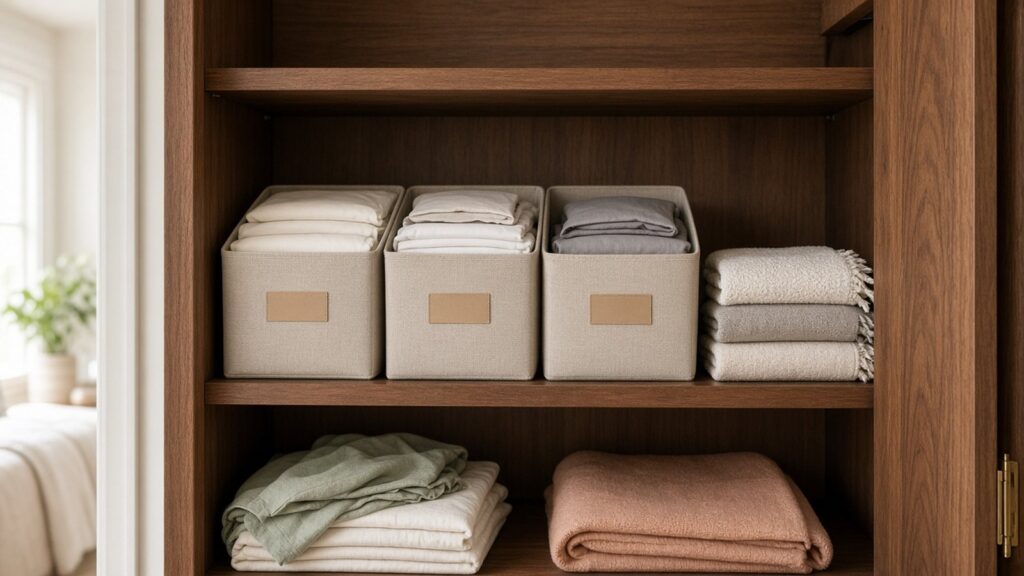
The best bed sheet organizer for a small linen closet is usually a foldable fabric bin sized for one sheet set, with a clear window and a blank label tag you fill in yourself. On a shallow shelf, matching bins stop piles from tipping and make Friday sheet changes grab-and-go. Below: what to measure, five SpaceAid options by pack size and color, and a simple system for everyday vs guest sets.
If your closet is mostly clothes with one high shelf, pair this guide with how to organize a small closet with no built-ins. For guest bedding that only comes out a few times a year, see our holiday guest room prep checklist.
Quick Picks by Situation
- Tiny linen closet, one or two beds: start with a 2-pack gray or white foldable bed sheet organizer (~$27).
- Several beds or rotating sets: a 4-pack gray folder (~$30) covers master + kids or a spare without buying twice.
- Guest extras and seasonal duvet covers: a 6-pack gray or 8-pack beige (~$50–$54) keeps holiday sets labeled and stacked.
What to Look For in a Bed Sheet Organizer
A good sheet set organizer is less about brand hype and more about fit. Every SpaceAid foldable unit on this page shares the same footprint on the live product pages: about 5″W × 15″D × 12.8″H, fabric sides, a circle window, and room for roughly one Queen or King sheet set plus a duvet cover and pillowcases. Treat those numbers as a starting point and measure your shelf before you buy.
1. Depth vs your linen closet shelf
Fifteen inches of depth is the make-or-break number. If your shelf is only 12–13 inches deep, the bin will stick out or force the door shut awkwardly. If the shelf is deeper than 15 inches, you can still use these—just leave a clear aisle in front so you can pull one bin without dragging the whole row.
2. Pack count (how many beds you actually make)
Count complete sets, not loose pillowcases. One set per bin keeps sizes from mixing. A studio or one-bedroom usually needs two bins (on-bed + clean spare). A family with guest extras often needs four to eight. Buying a bigger pack once is usually cheaper than stacking mismatched boxes later.
3. Clear window and blank label tags
The circle window shows color and fabric at a glance. The blank tags are meant for you to write size and room—Queen / Guest, Twin / Kids, King / Master—so nobody opens three bins to find the right fitted sheet.
4. Foldable fabric vs rigid boxes
Foldable fabric bins collapse when empty, which helps if you only keep guest linens for part of the year. Rigid plastic bins can feel sturdier, but they rarely compress and often need more vertical clearance. For a small linen closet, foldable bed sheet organizers usually win on flexibility.
5. Material and color that matches the closet
Non-woven fabric is light and breathable enough for sheets that get used regularly. Color is mostly visual: gray hides dust, white looks bright in a painted closet, beige blends with natural wood. Pick one color family so the shelf reads as one system, not a thrift-store pile.
How to Measure a Small Linen Closet Shelf
- Clear one shelf section so you can see the back wall and any support brackets.
- Measure usable depth from the front lip to the back wall (or to the pipe/bracket that sticks out). Write the smallest number, not the largest.
- Measure clear height between shelves. You need a little more than 12.8 inches so the zipper and label card are easy to grab.
- Measure width and divide by about 5 inches per bin to see how many can stand in a row. Leave finger space between bins.
- Check the door swing. If bins sit on a shelf behind a bifold or louvered door, make sure nothing hits the door when it closes.
No linen closet at all? Spare sets often live under the bed or in a hallway shelf—see under-bed storage ideas for small bedrooms if clearance is the constraint.
The Best Bed Sheet Organizers for a Small Linen Closet
All five options below use the same unit size (about 5 × 15 × 12.8 inches) and the same foldable fabric construction with a circle window. The differences are pack size, color, and price. Prices are approximate from the SpaceAid product pages on 2026-11-06 and change often—always confirm before you buy.
1. SpaceAid 2 Pack Foldable Sheet Organizer, Gray — best starter for 1–2 beds
The SpaceAid 2 Pack Foldable Sheet Organizer in gray is the simplest entry point for linen closet sheet storage. Around $27 for two bins. Gray hides fingerprints and looks calm next to white towels.
Pros: Low cost to try the system; foldable when empty; clear window + blank tags.
Cons: Only two bins—families or guest hosts will outgrow it fast.
Who it suits: Apartments, one bedroom, or anyone testing whether a bed sheet organizer beats pillowcase stuffing.
2. SpaceAid White Bed Sheet Set Storage Organizer, 2 Pack — best light-closet look
Prefer a brighter shelf? The white 2-pack bed sheet set storage organizer is the same size and capacity as the gray starter, also around $27. White shows dust sooner but matches painted linen closets and white towels.
Pros: Clean visual match for white shelving; same footprint as the gray 2-pack.
Cons: Still only two units; white fabric shows wear more than gray.
Who it suits: Small closets where you want the organizers to disappear into a light palette.
3. SpaceAid 4 Pack Bed Sheet Organization Folder, Gray — best mid pack / value
The 4 Pack Bed Sheet Organization Folder in gray is the sweet spot for most homes: enough bins for two beds with a spare each, or one bed plus kids and a guest set. Around $30 on the live page (pricing moves, so treat “Around $30” as a check-the-page number).
Pros: Best cost-per-bin of the smaller packs; gray is forgiving; covers most households without a bulk order.
Cons: Still not enough if you keep formal guest duvets and seasonal flannels year-round.
Who it suits: Busy households that rotate sets on a weekly house cleaning schedule and want Friday changes to be grab-and-go.
4. SpaceAid 6 Pack Foldable Bed Sheet Organizer for Closet, Gray — best for several beds
When you have kids’ rooms, a guest twin, and a master set, the 6 Pack Foldable Bed Sheet Organizer for Closet in gray (around $50) gives every set its own home without mixing sizes. Same unit dimensions—just more of them.
Pros: Enough capacity for a multi-bed home; uniform gray row looks intentional.
Cons: Needs shelf width for six 5-inch-wide bins (or two short rows); overkill for a studio.
Who it suits: Families who were already stacking loose sheet piles on one shelf.
5. SpaceAid 8 Pack Bed Sheet Organizer, Beige — best bulk / guest extras
Hosting a lot, or keeping flannel and percale for different seasons? The 8 Pack Bed Sheet Organizer in beige runs around $54 on the live page. Beige reads warmer than gray and blends with wood shelving.
Pros: Maximum pack on this list; beige looks soft in natural-wood closets; same foldable window design.
Cons: Highest upfront cost; eight bins need real shelf real estate—measure width first.
Who it suits: Large households, frequent hosts, or anyone consolidating hallway and bedroom linen piles into one system.
How to Organize Bed Sheets in a Linen Closet
Buying the bins is half the job. The other half is a boring, repeatable packing rule so the shelf stays tidy after laundry day.
- One complete set per bin. Flat sheet, fitted sheet, pillowcases, and—if it fits—the matching duvet cover. Do not mix Twin and Queen in the same organizer.
- Fold for the bin, not for a magazine photo. Fold sheets into a rectangle that slides in without forcing the zipper. If a King set is bulky, leave the duvet cover in a second bin labeled the same room.
- Write the blank tags yourself. Size + room (or “Guest”) is enough. Skip fancy printable labels until the system sticks for a month.
- Separate guest vs everyday. Put everyday sets at eye level. Park guest and seasonal sets on the higher shelf so they do not get opened every week.
- Return the empty bin to the shelf after you remake the bed. That empty slot is your reminder that one set is in the wash—helpful on Friday sheet day.
If drawer space is the bottleneck for pillowcases or spare pillow protectors, file folding to save drawer space keeps soft goods vertical instead of in a tipping pile. And if the linen closet is packed with stuff you never use, start with a quick pass from our decluttering checklist of 50 things to throw away.
Common Mistakes
- Skipping the depth measurement. A 15-inch-deep organizer on a 12-inch shelf will stick out forever.
- Stuffing two sets in one bin. You lose the whole point of grab-and-go linen closet sheet storage.
- Leaving tags blank. Six identical gray bins without labels become a guessing game within a week.
- Buying an 8-pack for a studio. Extra bins become clutter. Start with a 2-pack or 4-pack and add later.
- Storing damp sheets. Let everything dry fully before zipping; trapped moisture smells musty fast in a closed closet.
FAQ
What is the best bed sheet organizer for a small linen closet?
For most small closets, a foldable fabric sheet set organizer about 5 × 15 × 12.8 inches with a clear window works well—if your shelf is deep enough. A 2-pack or 4-pack is usually enough unless you keep many guest or seasonal sets.
How do you organize bed sheets in a linen closet?
Keep one complete set per bin, label size and room, put everyday sets at eye level, and park guest sets higher up. Fold to fit the bin rather than aiming for perfect hospital corners.
Do foldable bed sheet organizers fit Queen and King sets?
SpaceAid’s product copy says each unit holds about one Queen or King sheet set plus a duvet cover and pillowcases. Bulky hotel-style or flannel sets may need the duvet cover in a second bin—fold a test set before you commit a whole shelf.
How deep should a linen closet shelf be for sheet storage?
Plan for at least the organizer’s depth (about 15 inches for these foldable bins) plus a little finger space in front. Always measure your own shelf; brackets and door frames steal usable depth.
Pick a Pack Size, Then Measure Twice
The best bed sheet organizers for a small linen closet are the ones that fit your shelf and match how many beds you actually make. Start with a 2-pack if you are testing the habit, step up to a 4-pack for most homes, and only go 6–8 when guest and seasonal sets have nowhere else to live. Measure depth first, label every tag, and Friday sheet changes get simpler without a closet remodel.



Leave a Reply