

This post may contain affiliate links. If you buy through them, we may earn a small commission at no extra cost to you. Learn more
The best small kitchen organization ideas all do the same thing: they give every item one home, put daily things within reach, and use the space you usually ignore, like cabinet height, door backs, wall strips and the gap beside the fridge. Start by clearing what you never use, split the kitchen into zones (pantry, fridge, counter, cabinets and drawers, walls, under the sink), then add storage only where a zone keeps overflowing.
Below are 12 quick hacks, organized by zone, so you can fix the spot that bugs you most today instead of overhauling the whole room. Where a zone has its own full guide on LifeUp Daily, you will find a short summary and a link instead of a repeat. There is also a section on fitting Thanksgiving leftovers into a small fridge, since late November is when tiny kitchens feel smallest.
How to Organize a Small Kitchen in 4 Quick Moves
Before you buy a single bin, run through these four moves. They take an afternoon and make every hack below work better.
- Clear the counters and one cabinet at a time. Working in small batches keeps the kitchen usable while you sort.
- Edit hard. Duplicate spatulas, gadgets you used once, mugs you never reach for and expired food go first. If you want a list to work from, the 50-things decluttering checklist has a kitchen section.
- Group what is left by job: cooking, baking, food storage, coffee and drinks, cleaning, snacks.
- Store each group near where you use it. Pans by the stove, mugs by the coffee maker, containers near the fridge. Then measure the spots that are still overflowing; those measurements decide what (if anything) you buy.
12 Small Kitchen Organization Ideas by Zone
Each zone below gets two or three hacks. You do not need all 12. Pick the zones that cause the most daily friction and start there.
Small pantry organization ideas (hacks 1-3)
A small pantry, whether it is a narrow closet, one tall cabinet or a single shelf, works best when food is grouped and visible. The short version:
- Use bins like drawers. Put each category (breakfast, baking, snacks, pasta and grains) in its own open bin or basket that you pull out in one move. Nothing gets lost at the back, and restocking is just refilling a bin.
- Lift cans and jars so you can read them. A tiered riser or a can organizer lets you see every label at once, so you stop buying a third can of tomatoes. Sotfamily, for example, makes can organizers and stackable soda can racks for the pantry; measure your shelf depth first.
- Claim the back of the door. An over-the-door rack holds spices, wraps and snack packets in a space that is otherwise empty.
No real pantry at all? The full method for freestanding bins, rolling carts and risers is in how to organize a small pantry without shelves.
Small fridge organization (hacks 4-5)
- Give every shelf a job. Ready-to-eat food and leftovers at eye level, drinks and condiments in the door, raw meat on the bottom shelf in a container or on a tray so nothing drips onto other food. When each shelf has a job, you can see at a glance what needs eating.
- Corral small things in clear bins. Yogurt cups, cheese, sauces and snack packs disappear on wire or glass shelves. A narrow clear bin per category (or a small turntable for jars) turns a deep shelf into something you can pull forward. If you want ready-made pieces, see Sotfamily’s refrigerator storage organizers.
A full fridge zone system is coming in its own post. For now, those two hacks cover most small-fridge chaos.
Counter hacks (hacks 6-7)
- Keep only daily-use items out. If you do not use it most days, it lives in a cabinet. Group the survivors on one tray by the stove (oil, salt, pepper, a utensil crock) so the rest of the counter stays clear for prep. If your coffee setup is the one thing that earns permanent counter space, keep it in one compact corner; the coffee lover gift guide covers small-footprint moka pots and frothers.
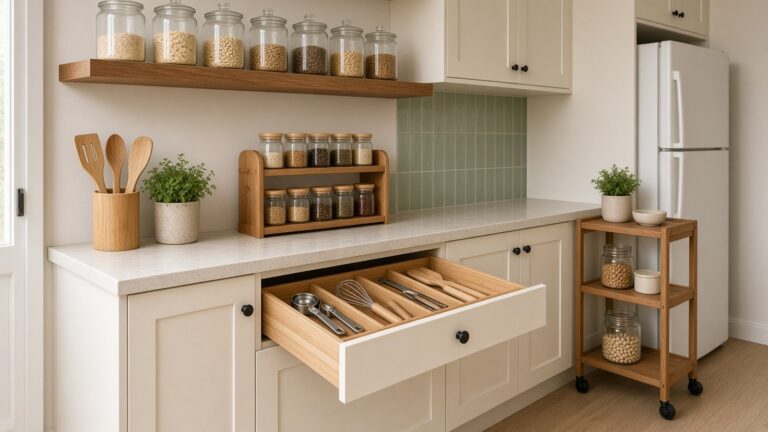
- Add a slim rolling cart. A narrow cart in the gap beside the fridge or at the end of the counter holds jars, produce or small appliances and rolls out when you need it. It is extra counter, pantry and storage in one piece that you can take with you when you move.
Small kitchen storage ideas for cabinets and drawers (hacks 8-10)
- Double cabinet shelves with risers. Most cabinet shelves have empty air above a single stack of plates. A shelf riser creates a second level: plates on top, bowls underneath, or mugs on both. The SpaceAid 2-pack cabinet shelf organizers are 13 inches wide and rated for up to 30 pounds per shelf, according to the product page.
- Turn deep lower cabinets into drawers. Pans and food containers at the back of a base cabinet are effectively gone. A pull-out drawer brings them forward. The SpaceAid no-drill pull-out cabinet drawer adjusts from 11.8 to 19.6 inches wide and installs with adhesive, so measure the inside of the cabinet opening (including hinges) before ordering. For food containers specifically, follow the steps in how to organize Tupperware and food containers.
- Divide drawers and step up spices. Utensil drawers stay tidy when every type has a slot. Bamboo dividers work well here; Bellsal makes bamboo drawer dividers and kitchen drawer organizers. For spices in a cabinet, a tiered shelf keeps the back row visible: the SpaceAid 3-tier bamboo spice rack expands from 12 to 22 inches wide. Food storage bags get their own fix in the ziplock bag organizer guide.
Walls and vertical space (hack 11)
- Use walls and cabinet doors. A rail with S-hooks for mugs or utensils, a magnetic knife strip, a slim shelf above the stove or sink, and racks on the inside of cabinet doors for lids, wraps or spices all add storage without taking floor or counter space. More ideas, including no-drill options, are in 12 vertical storage ideas for small apartments.
Under the sink (hack 12)
- Give the sink cabinet two zones and a caddy. Daily cleaning supplies in a carry caddy at the front, refills and backups behind. A tension rod for spray bottles frees the floor of the cabinet. The full step-by-step, including working around pipes and a garbage disposal, is in under-sink kitchen organization ideas.
How to Store Thanksgiving Leftovers in a Small Kitchen
A small fridge on the day after Thanksgiving is a puzzle. A little planning makes it fit:
- Eat the fridge down first. In the week before the holiday, plan meals around what is already in there, and move drinks to a cooler on the day so the shelves are free for food.
- Have containers ready before dinner. Matching, stackable containers fit far better than odd bowls with plastic wrap. If your container cabinet is a mess, sort your Tupperware a few days ahead.
- Go shallow and flat. Carve turkey off the bone and portion everything into shallow containers so it cools faster and stacks neatly. Soups, gravy and stuffing can go into freezer bags laid flat; once frozen, they stand up like files.
- Follow the food-safety basics. USDA guidance is to refrigerate leftovers within two hours and use them within 3-4 days, or freeze them. Write the date on each lid.
- Make an “eat first” spot. One shelf or one bin at eye level for leftovers means nobody has to dig, and nothing gets forgotten behind the milk.
- Send some home. Ask guests to bring a container, or keep a stack of inexpensive ones for to-go plates.
For the full hosting plan, including a printable timeline, see the Thanksgiving hosting checklist.
Small Kitchen Storage Ideas If You Rent
Renters can use almost every hack above, as long as it can leave with you: freestanding risers, carts, tension rods, over-the-door racks and adhesive pull-outs instead of drilled shelves. Test adhesive products on a hidden spot first and follow the removal instructions when you move out. For more no-damage options, see renter-friendly storage hacks, and if your kitchen is one wall of a studio, the studio apartment organization guide shows how to zone it.
Common Mistakes
- Buying organizers before decluttering. You end up organizing things you do not need, and the bins fill up in a week.
- Not measuring. Cabinet depth, shelf height and the gap beside the fridge decide what fits. Measure twice, including hinges and pipes.
- Filling every inch. A packed shelf is hard to use. Leave a little breathing room so things go back easily.
- Storing by habit, not by use. If you walk across the kitchen for the same item every day, move it.
- Treating the counter as storage. Every item that lives on the counter takes away prep space. Keep it to daily-use things only.
FAQ
How do I organize a small kitchen with no pantry?
Pick one tall cabinet, a freestanding shelf or a rolling cart as your pantry and group food in bins by category. The pantry-without-shelves guide walks through the options.
How can I maximize storage in a small kitchen?
Use height: shelf risers in cabinets, racks on cabinet doors, wall rails and a shelf above the stove or sink. Then turn deep cabinets into pull-outs so nothing gets lost at the back.
What should I keep on a small kitchen counter?
Only what you use most days, such as a utensil crock, oil and salt, and maybe the coffee maker. Everything else goes into a cabinet or onto a cart.
How do you organize a small fridge?
Give every shelf a job, put small items in clear bins, keep raw meat on the bottom shelf in a container, and leave one eye-level spot for leftovers so they get eaten.
Start With One Zone This Week
A small kitchen does not need a renovation, just a home for everything and fewer things competing for space. Pick the zone that frustrates you most, try two of these hacks this week, and add the next zone when that one is working.



Leave a Reply