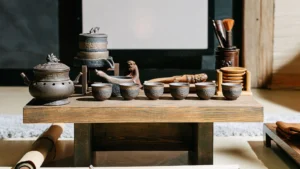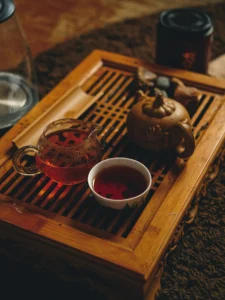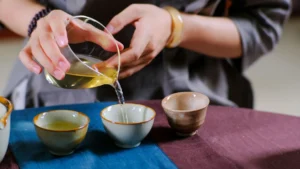
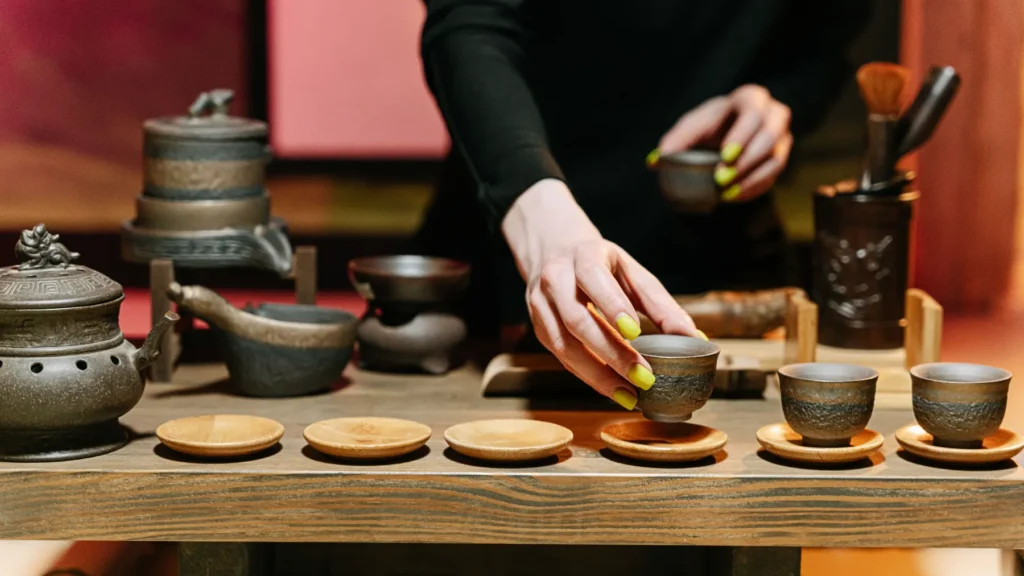
The first time most people see a traditional gongfu tea setup, the tiny cups are what catches their attention. They hold maybe a couple of sips each — barely more than a shot glass. The assumption people usually land on is that it’s an aesthetic choice, part of the overall elegance of the ritual. It isn’t. The size solves a very specific, practical problem.
For a broader introduction to tea types, teaware, and simple brewing, see our Chinese tea beginner’s guide.
It’s Not About Elegance — It’s About Freshness
The main job of a small cup is to make sure you’re drinking the tea at its best, not partway through its decline. A full-sized mug holds enough liquid that it takes several minutes to work through, and tea changes fast during that window — it cools, and along with the temperature, some of the aroma and flavor fade too.
A small cup sidesteps that problem entirely. You drink it in one or two sips, while it’s still close to the exact temperature and flavor it had the moment it was poured. Every cup is, in effect, a fresh moment — not the tail end of one that started ten minutes earlier.
It’s Designed Around Re-Steeping, Not Against It
This ties directly into how gongfu-style tea is actually brewed. Rather than one large pot meant to last a whole sitting, the tea is steeped in small batches, many times over — sometimes ten or more infusions from the same leaves. If the cups were large, there simply wouldn’t be enough tea from a single infusion to fill them properly.
The small cup and the many-infusion brewing method are built for each other. Instead of pouring one big serving and drinking it down as it slowly loses its edge, you get a series of small servings, each one freshly poured. The cup size isn’t limiting how much tea you drink — it’s just splitting that total amount into a string of moments where the tea is always at its best, rather than one long stretch where it isn’t.
That’s also part of why gongfu tea tends to feel more deliberate than a normal cup of tea. It’s not that the cups are small for the sake of looking refined — the ritual feeling comes from the fact that you’re re-engaging with a fresh cup again and again, instead of drinking on autopilot from one large mug until it’s empty.
The Part That’s Easy to Miss: It’s Also About Hospitality
There’s a social layer to this that’s easy to overlook if you’re only thinking about the tea itself. Small cups mean the person pouring — usually the host — ends up refilling them frequently throughout a gathering. That repeated act of pouring is doing more than just keeping cups full; it’s a small, constant gesture of attention toward the people you’re serving.
Compare that to a Western setup, where a host pours one large cup and guests largely serve themselves after that. With small Chinese tea cups, the host stays involved — pouring again, and again, and again over the course of a conversation. The frequency itself is part of the hospitality. A guest whose cup keeps getting quietly refilled is a guest who’s being looked after.
The Bottom Line
Next time you’re drinking from one of these small cups, what you’re actually experiencing is a bit of quiet design logic — a system built to keep every sip fresh, to match the rhythm of repeated infusions, and to give a host a reason to keep showing up at your side with the pot. It’s not smaller for the sake of looking nice. It’s smaller because that’s what makes all three of those things work.
Curious how this same “many small infusions” logic plays out with pu-erh specifically? We cover it in How Many Times Can You Re-Steep Pu-erh Tea.