
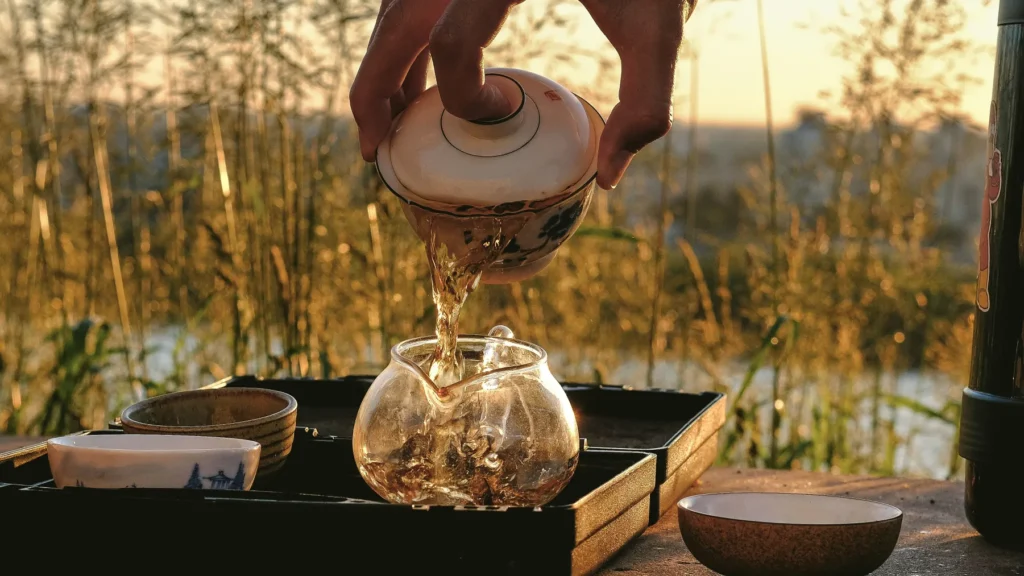
If you’ve ever poured boiling water into a gaiwan, picked it up with confidence, and then immediately dropped it back onto the table with a yelp — welcome to the club. Nearly everyone who starts brewing tea this way goes through the same moment: hot porcelain, wet fingers, and a split second of panic before the lid clatters back down.
It’s not a sign you’re doing something wrong on a deeper level. It’s just a hand-eye coordination problem that hasn’t been solved yet. And it’s solvable in about a week of practice.
Why Gaiwans Burn Your Fingers in the First Place
A gaiwan — literally “lidded bowl” — was never designed with a handle, because the whole point of the vessel is direct contact. Unlike a Western teapot, which insulates you from the tea on purpose, a gaiwan puts your fingers close enough to feel the water’s heat right through the porcelain. That’s part of how experienced brewers judge temperature and steeping time without a thermometer.
The burning usually comes down to three things:
- Overfilling. Water poured too close to the rim means your fingers sit lower, closer to the heat, when you tilt the vessel to pour.
- Hesitation. The longer your skin stays in contact with hot porcelain, the worse it gets. Most beginners get burned not because their grip is wrong, but because they freeze for half a second too long deciding how to pour.
- The wrong gaiwan for a beginner’s hand. Thin-walled porcelain heats up almost instantly and holds very little heat buffer. It’s beautiful, but it’s brutal for a first-timer.
It’s also worth pointing out something most guides leave out entirely: the porcelain itself isn’t the only heat source. The moment you crack the lid open, a burst of steam escapes right past your fingers — and that steam can catch you off guard even if you’ve braced yourself for the bowl’s temperature. Beginners tend to prepare for one kind of heat and get surprised by the other.
That last point matters more than most guides admit — the gaiwan you start with can make this whole learning curve easier or harder. More on that below.
How to Hold a Gaiwan Without Burning Your Fingers
Here’s the grip that most tea drinkers eventually land on, broken into steps you can actually practice:
1. Find your grip points. Rest your thumb and middle finger on the rim of the bowl itself — not the lid, the bowl. They should sit almost opposite each other, like you’re pinching the vessel from two sides.
2. Use your index finger to control the lid. Your index finger presses lightly on the lid’s knob, just enough to hold it in place and create a small gap for pouring. You’re not gripping hard here — you’re balancing.
3. Tilt, don’t lift. Rather than picking the gaiwan straight up, tilt it away from you in one smooth motion. The faster and more decisive the tilt, the less time your fingers spend against the hot surface.
4. Pour in one continuous motion. Don’t pause halfway through pouring to “reassess.” Commit to the pour once you start it. Hesitation is where most burns happen.
5. Set it down immediately after pouring. The moment the last of the liquid is out, put the gaiwan back down. There’s no reason to hold it a second longer than necessary.
None of this needs to look elegant on day one. Tea masters spend years refining this into something that looks effortless. Your only job right now is to not get burned while you build the muscle memory.
Choosing a Gaiwan That’s Actually Beginner-Friendly
This is the part most tutorials skip, and it’s arguably more useful than the grip itself: not all gaiwans are equally forgiving.
- Thicker porcelain walls hold heat a bit longer before transferring it to your fingers, which buys you an extra second or two of margin while you’re still learning the tilt-and-pour motion.
- A slightly wider rim gives your thumb and middle finger more surface area to rest on, away from the hottest part of the bowl near the water line.
- Mid-size capacity (100–120ml) is easier to control than the very small, delicate gaiwans experienced brewers often prefer — those hold less water but concentrate heat closer to your fingers.
If you’re shopping for your first one, look for a simple, slightly thicker porcelain gaiwan in this size range rather than the thinnest, most translucent option in the shop. You can graduate to the elegant thin-walled ones later, once the grip is second nature.
If You’re Still Getting Burned
A few things that even long-time tea drinkers quietly rely on:
- Don’t fill past 80% capacity. Less water means less weight pressing your fingers down toward the hot rim.
- Pour slightly faster than feels natural. Beginners tend to pour too cautiously, which extends contact time. A confident, steady pour is actually safer than a slow, careful one.
- Practice with lukewarm water first. Run through the grip and tilt motion a few times with water that’s warm, not boiling, before you commit to a full brew. Your hands will remember the motion once the stakes are lower.
This is a hand-feel skill, not a talent. Nobody picks up a gaiwan for the first time and pours like they’ve done it for a decade — they just don’t show you the fifty times they got it wrong first.
And honestly, give yourself permission to ease into it. All of the grip and pour technique above takes time to feel natural, and there’s no shame in needing a buffer while your hands adjust. If none of the finesse is working for you yet, there’s a low-tech trick a lot of beginners swear by: keep a small desk fan — even a 7-inch one — pointed at your hands, and switch it on right as you lift the lid. The steady airflow carries the steam away and cools the porcelain just enough to take the edge off. It’s not elegant, and no tea master is going to teach it to you, but it works, and it buys you the breathing room to actually focus on the technique instead of bracing for pain.
Next up: once you’re comfortable with the gaiwan, you might be wondering whether it’s worth adding a Yixing teapot to your setup — or if one vessel is enough to start. We break down Gaiwan vs Yixing Teapot: Which Should Beginners Buy First in the next post.
For the full process beyond the grip itself, read our complete beginner’s guide to using a gaiwan, covering tea selection, leaf ratios, water temperature, rinsing, repeated infusions, and cleaning.


Pingback: Sheng vs Shou Pu-erh: A Beginner's Guide Without the Jargon - LifeUpDaily
Pingback: Best Budget Gaiwan Sets for Beginners (Under $30) - LifeUpDaily
Pingback: Why Chinese Tea Culture Doesn't Have a Fixed "Ceremony" (Unlike Japan) - LifeUpDaily
Pingback: A Minimalist's Guide to Starting a Home Tea Corner - LifeUpDaily
Pingback: Oolong Tea Types Explained: Wuyi, Anxi, and Taiwan High Mountain - LifeUpDaily
Pingback: Gaiwan vs Yixing Teapot: Which Should Beginners Buy First - LifeUpDaily
Pingback: What Water Temperature Ruins Green Tea (And How to Fix It) - LifeUpDaily
Pingback: How Many Times Can You Re-Steep Pu-erh Tea - LifeUpDaily